Wednesday, February 19, 2020

C V Swaminatha Iyer and the Viveka Chintamani

The history of Tamil journalism is a long and interesting one. While the propagation of religion was primarily the focus of early Tamil magazines (the first one being the eponymous Tamil Magazine which was brought out by the Religious Tract Society in 1831), it changed over a period of time to serve other objectives such as dissemination of knowledge on literature, science, art, culture etc. The pioneer in this regard was the ‘Dinavarthamani’, which was founded in 1855 and was edited by Father Percival. This piece is about one such magazine of general interest, the Viveka Chintamani which was founded in 1892 by a man who is not much spoken about today for his contribution to the world of Tamil journalism, CV Swaminatha Iyer.

He was born in 1863 in Tiruvaiyaru. Nothing much is known about his family except that it had once been a wealthy one whose fortunes had dwindled over a period of time. His father Venkatarama Iyer however ensured that the family circumstances did not stand in the way of his son’s education, which was completed at Kumbakonam.

Swaminatha Iyer’s tryst with journalism came about quite as a matter of chance. While on a visit to Madras in 1885, he came into contact with G Subramania Iyer, the proprietor of The Hindu, who had started the Swadesamitran three years earlier. With the job of running two newspapers proving to be an arduous one, Subramania Iyer was on the lookout for a person who would take care of the fledgling Swadesamitran. The mantle fell on Swaminatha Iyer, thus marking the beginning of a long journey in the world of journalism. Though Subramania Iyer remained the publisher and editor in name, it was Swaminatha Iyer who ran the show, as several accounts of the life of G Subramania Iyer and the early years of the Swadesamitran record. Swaminatha Iyer’s stint at Swadesamitran lasted for a decade. This experience would come in handy when he would go on bring out the Viveka Chintamani.

It was around this time that several associations such as the Triplicane Literary Society and the Madras Hindu Reform Association were founded to promote public discussions and thought on various socio-political issues prevailing at that point of time. In the early 1880s, G Subramania Iyer and M Veeraraghavachariar founded the Society for the Diffusion of Useful Knowledge on the lines of the eponymous organisation that had been founded in London in 1826. The organisation mainly aimed at the creation of political awareness and knowledge amongst the masses. It however did not last for long as dwindling interest finally led to its closure in the 1890s. The idea did not die, for it served as an inspiration to Swaminatha Iyer to start an organisation on similar lines. Thus, was born the Diffusion of Knowledge Agency on March 1st, 1892, its primary objective being promotion of the habit of reading amongst the vast rural population and creating opportunities for learning. In order to carry out its objectives, Swaminatha Iyer began a monthly magazine, Viveka Chintamani, the first issue coming out in May 1892.

Viveka Chintamani was 32 pages in size and had articles on a variety of topics such as science, moral instruction for students, current affairs etc. As early as the second issue, it had a page exclusively for children, probably the first magazine to do so. It also had a separate section for women. The magazine had several significant achievements, particularly in the field of Tamil fiction to its credit. It serialised Kamalambal Charithram by the young BR Rajam Aiyar, which was perhaps only the third novel in Tamil. The story ran for two years, between February 1893 and January 1895. The following year, it was brought out as a book by CV Swaminatha Iyer. It serialised the early episodes of A Madhaviah’s work Savithri Charithram in 1895, before it was stopped abruptly for reasons unknown. The magazine would later carry his work Muthumeenakshi. It also carried book reviews and short stories of authors such as Milton, Rabindranath Tagore etc translated into Tamil.

Viveka Chintamani also actively promoted the study of the Tamil language. It ran several articles on its literary and grammatical aspects. ‘Parithimaar Kalaignar’ VG Surayanarayana Sastriar wrote a series on the life of many Tamil poets, which was released as a compilation titled ‘Tamilppulavar Charithram’ after his death in 1903.

Very interestingly, the magazine came in two editions, a thick paper one for ‘schools, patrons, reading rooms and circulating libraries’ and a thin paper one for the masses. The office, which was in Sydoji Lane, Triplicane was shifted the Swaminatha Iyer’s residence Lalitalaya in Adam Street in Mylapore around 1908 or so.

CV Swaminatha Iyer was a man of several other interesting facets. He was a highly spiritual personality. An active practitioner of Kundalini Yoga, he was also a Srividya Upasaka, who took on the monastic name of Satyananda. He founded the Ananda Mission in 1903 in Chidambaram, whose aim was the ‘the propagation of Truth and Knowledge as the way to Health, Happiness and Life through self-help, self-control and self-culture’. It sought to work for the ‘uplift of humanity by uplifting of human thought above the considerations of the lower self’. He believed staunchly in the sovereignty of the rule of the King Emperor and led the initiative to appeal for the renaming of Black Town as George Town following the Coronation Durbar in 1905. The name change was announced the following year. His ardent support of the sovereignty however did not stand in the way of his taking an active part in the proceedings of the case that followed the Arbuthnot Bank crash in 1906. He had lost nearly Rs 20000 in the crash. It was following his petition that Justice Boddam, a preference shareholder (and therefore an interested party) of one of Arbuthnot & Co’s main assets, the shares of Arbuthnot Industrials Limited recused himself as the Insolvency Commissioner.

Approaching the age of sixty, Swaminatha Iyer handed over the reign of Viveka Chintamani to his elder son, Sadanand soon after the completion of its Silver Jubilee year in 1917. It however did not last for much longer, winding up in the 1920s. Sadanand was however on his way to becoming a legend in his own right in the field of journalism. He founded the nationalistic Free Press Journal Agency in Bombay and ran the eponymous paper in the 1930s. He bought the Indian Express from Dr P Varadarajulu Naidu in 1933 and ran it for a while, before it was taken over by Ramnath Goenka. He was also one of the seven founding shareholders of the Press Trust of India. Swaminatha Iyer’s younger son, Dr S Natarajan (more popularly known by his pen name, Najan) too would carry on his father’s legacy. A renowned Srividya Upasaka, he wrote more than 100 books in his lifetime on diverse topics.
Lalitalaya’s tryst with journalism continues till date, with Dr Natarajan’s son running a publishing unit from the redeveloped premises.

ACKNOWLEDGEMENTS:
1. Various issues of Viveka Chintamani
2. Indhiya Viduthalaikku mundhaiya Tamizh idhazhgal, (Part 1), E Sundaramoorthy and Arasu M.R, International Institute of Tamil Studies, 1998.

Sunday, July 7, 2019

When Tamizh Thatha turned 80


Dr. U. Ve. Swaminatha Iyer was one the foremost scholars of the Tamil language. Born in Uthamadhanapuram in Tanjavur district on 19 February 1855, Swaminatha Iyer dedicated his life to the study and research of Tamil. One of his biggest contributions was bringing to light several literary classics such as the Jeevakachintamani, Pathuppatu, Silappadhikaram, Manimekalai etc., works that had hitherto been known only through passing references in other pieces of Tamil literature. His painstaking efforts, which involved going in search of and collecting palm leaf manuscripts from various sources, resulted in a huge body of work and earned him several admirers and dedicated followers, besides the moniker Tamizh Thatha. In 1935, when he turned 80, a group of prominent well-wishers from Madras took it upon themselves to celebrate the occasion in a grand manner.

A committee titled the ‘Mahamahopadhyaya Dr. V. Swaminatha Iyer 81st Birthday Celebration Committee’ was formed under the chairmanship of Sir P.T. Rajan, the Justice Party leader who would become the Chief Minister of the Madras Presidency the following year. Popular science writer P.N. Appuswami and noted Tamil lexicographers T. Sivaramasetu Pillai and S. Vaiyapuri Pillai were the Secretaries, while Rao Bahadur K.V. Krishnaswami Ayyar served as its Treasurer.

In its appeal calling for public donations dated February 6, 1935, the Committee noted Dr. Swaminatha Iyer’s contribution to the world of Tamil and his role in the resuscitation of the great classics of Tamil literature. It credited his work as being instrumental in reforming the prevailing conception of ancient Tamil culture and added that, in other countries, such occasions were celebrated on a magnificent scale by publishing memorial volumes, raising commemorative statues etc. The Committee proposed to express its gratitude to Dr. Swamintha Iyer by presenting an address on his birthday and installing his portrait at the Madras University.

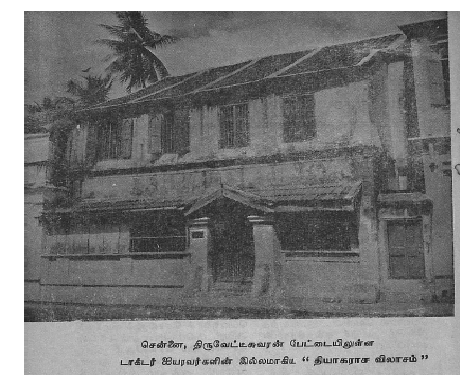
An account of the birthday celebrations on 6 March 1935, published by the Madras Law Journal Press, makes for interesting reading. The sathabhishekam was performed by Dr. Swaminatha Iyer’s son Kalyanasundara Iyer in a grand manner, following all ritualistic traditions at their home ‘Thyagaraja Vilas’ in Pillaiyar Koil Street, Tiruvatteeswaranpet (now demolished). In the afternoon, an address was presented to Dr. Swaminatha Iyer by some of his former students, in the form of a poem of three stanzas, which paid tribute to the services rendered by him to the study of Tamil literature. The poem was composed by his star pupil, Vidwan K.V. Jagannatha Iyer (Ki.Va.Ja.). Amongst those present on the occasion were Prof. K. Sundararama Iyer, Dewan Bahadur K.S. Ramaswamy Sastri and a representative of the Dharmapuram Adheenam.


That evening, a large and distinguished gathering of citizens met at the Senate House for the unveiling and presentation of Dr. Swaminatha Iyer’s portrait. A tea party with catering by Ramakrishna Lunch Home was hosted by Kalyanasundara Iyer on its lawns, after which the public meeting commenced. P. N. Appuswamy read out a number of messages received from friends and well-wishers of Dr. Swaminatha Iyer, such as Sir C.P. Ramaswamy Iyer, Sir T. Desikachariar, the Rt. Hon’ble V.S. Srinivasa Sastri, Sir M. Devadoss and the Raja of Ramnad. Sir P.T. Rajan presented a purse containing Rs 3,001 on behalf of the Committee to Dr. Swaminatha Iyer.

Two interesting gifts received were a cheque for Rs 501 sent by an anonymous donor, with a request that it be utilised by Dr. Swaminatha Iyer towards penning his memoirs in the form of a book and a 60-year-old stylus presented by R. Krishna Rao Bhonsle on behalf of the Board of Studies in Tamil and Kannada of the Andhra University.


Addresses in tastefully done gold and silver caskets were presented on behalf of several organisations such as the Madras Tamil Pandits Sangam, the Sanskrit Academy, the Madras Library Association and the Tamil Lexicon Committee. The Old Boys Association of the Kumbakonam College (where Dr. Swaminatha Iyer had taught for 23 years) and the Tamil students of the Presidency College (where he took up employment in 1903 on his transfer to Madras) presented addresses too, as did the students of Loyola College and the Government Mahomedan College.

Sir Mohammad Usman, the Chief Guest of the evening, unveiled the portrait (executed by artist Dorai), which had been presented to the Senate by the Tiruppanandal Adheenam, a prominent patron of the Tamil language. Paying rich tributes to Dr. Swaminatha Iyer, Sir Mohammad Usman noted that it was thanks to the Tamil scholar’s efforts that the Adheenam had instituted a scholarship of Rs 1,000 to be awarded every year to the student who stood first in the Vidwan’s examination. The portrait was received by the Vice Chancellor of the University of Madras, R. Littlehailes who, in his address, recognised the scholar’s achievements and took great pride in the fact that the University had conferred a Doctorate on him a few years earlier for his services to the Tamil language.

In his acceptance speech, Dr. Swaminatha Iyer gratefully acknowledged all the praise and gifts received, and humbly submitted that these were to be attributed to the love of the donors for the Tamil language. He added that his success was largely due to his master Meenakshisundaram Pillai and recalled the help he had received from various people in the course of his journey, mentioning in particular Thyagaraja Chettiar, the Tamil Pandit who had recommended his name for the post of Tamil teacher at Kumbakonam College.

Copies of the 64-page special issue brought out by the Kalaimagal magazine, to which Dr. Swaminatha Iyer was a regular contributor, were presented to the gathering. A concert by Harikesanallur Muthiah Bhagavathar provided a fitting finale to the grand celebrations.

The celebrations were not restricted to Madras city. Meetings were held across several places in the Presidency such as Kumbakonam, Erode, Madurai and Tirunelveli to commemorate the occasion. Celebrations were also held at Rangoon and Jaffna, where a portrait of Dr. Swaminatha Iyer was unveiled at the Kala Nilayam Hall, evidencing the far-reaching impact of his work.

Sunday, April 21, 2019

R.I.P Chief

My first proper meeting with Mr Muthiah (Chief to us at Madras Musings, in the words of MMM) was sometime in early 2009. Though I had met him briefly in Jan 2008 at a seminar organised by Chennai Heritage and had gone on to write 3-4 pieces for Musings that year, my correspondence with him had been chiefly over email till then. I was therefore surprised when I got an email requesting me to meet him regarding an article I had written for favour of publication.

I went to his residence where I was greeted with a sight of him seated at his huge table whose top could barely be seen thanks to the books, files and other papers that lay all over. Having warmly welcomed me, he proceeded to critically discuss the piece I had sent, giving me sound advice on how NOT to write articles for Madras Musings! It was indeed a chastening experience, one that promptly dispelled any notions that I had had of being a columnist. To my dispirited self however, there was a major takeaway from the conversation viz., never to make a profile of a person sound like a CV.

As my professional and theatre commitments grew, I started writing more sporadically and by 2013 or 2014, had completely stopped writing for Musings. Every time I met him at some event or the other, his first question would be to enquire as to why I was not writing any more. My reasons for the same would be met with a small grunt of disapproval followed by a comment that one should never find excuses to not write and urging me never to give up research and work on new ideas. It was however not until 2017 that I finally started to write regularly for Musings, though I must say it was my great fortune that I had the opportunity to write the introductory piece to the Arts section in the Madras Musings Silver Jubilee Commemorative Volume in 2016.

Even during the period when I wasn't writing for Musings, he would unfailingly send out a personalised mail every December wishing a Happy New Year. The short and simple message always exuded genuine warmth.

My favorite memory of Mr Muthiah is from my wedding reception. An aunt of mine saw him sitting all by himself at the back of the hall apparently waiting for the line to greet us thin down and brought him straight to the dais. He presented us with a copy of his book Queen of the Coromandel, signed in his usual style. Couple of days later, I got an email from him asking me to thank my aunt on his behalf for helping him out that evening!


Chief, you shall forever be spoken about in the same breath as Henry Davison Love, James Talboys Wheeler and Somerset Playne in the list of legendary chroniclers who have given us all that we know of our beloved Madras. You and your work shall live on through every person taking interest in the glorious heritage of our city.

R.I.P Chief.

Tuesday, February 5, 2019

From India's Digital Archives-14: Anandaranga Vijaya Champu

‘Ananda Ranga Vijaya Champu’ by Srinivasa Kavi is a work in Sanskrit composed in 1752 on the life of one of the greatest chroniclers of South India, Ananda Ranga Pillai, the noted Dubash. In 1937, Dr V Raghavan, noted scholar embarked on a project of editing this work and providing additional material by way of notes and Sanskrit commentary. This was published in 1948 and forms the subject of this piece.

Ananda Ranga Pillai was born in 1709 in Perambur. His connection with Pondicherry, where he was to make his name was a familial one, for his uncle Nainiya Pillai had been appointed the Chief Agent of the French East India Company in 1704. His father Tiruvenkata Pillai settled in Pondicherry along with several other merchants at the behest of Nainiya Pillai and became a successful businessman. While Nainiya Pillai fell out of favour with the French and died a prisoner, Tiruvenkata Pillai went from strength to strength and earned himself a respectable position. On his death in 1726, Ananda Ranga Pillai joined the government and in a span of a decade rose to become its Dubash.

As Dubash, he was a close confidant of Francois Dupleix, the Governor General and often his personal adviser. In addition to assisting the French with their trade, he carried on private trade himself and became extremely wealthy, becoming master of several villages such as Acharapakkam, Tindivanam, Bhuvanagiri etc. That he wielded tremendous power was evidenced by the fact that he was the pivot of all negotiations between the French and Indian princes. Today, he is chiefly remembered for his seminal work, the diaries he maintained which chronicle the political and other developments that shaped the history of South India in the 18th century. These were translated from Tamil in the early 20th century and published as the Private Diaries of Ananda Ranga Pillai over several volumes. He was however not a pioneer in this regard, for he had only inherited the habit from his cousin and Chevaliar Guruva Pillai, the son of Nainiya Pillai. Guruva Pillai’s diaries have not been recovered.

Like several other Dubashes, Ananda Ranga Pillai was a patron of several musicians, dancers and poets. Dr V Raghavan says that he possessed some musical knowledge too, which Francois Dupleix seems to have noted when informed by Pillai that his (Dupleix’s) glories had been composed into songs. The diaries also record that at the specific request of Dupleix, an enactment of French exploits with songs composed by Kavi Kasturi Rangayya, one of the poets patronised by Pillai was performed when the English withdrew from the siege of Pondicherry. Some of the Tamil poets who sought Pillai’s patronage were Sadasiva Desikar, Madhurakavi, Namachivayappulavar and Javvadhuppulavar. A Sanskrit poet who was patronised by him was Srinivasa Kavi, the author of this work. Nothing much is known about him except that he hailed from the North Arcot district.

In his preface to the book, Dr V Raghavan explains the significance of this work on two specific counts. One, it describes the battle of Ambur in 1749 (led by Chanda Sahib in a bid to capture power at Arcot, backed by Dupleix) and the murder of Nasir Jung in 1750 (son of Nizam-Ul-Mulk of Hyderabad) and secondly, for the fact that it explains the origins of the name Chennapatnam (held to be an abbreviated form of Chennakesavapura). Dr Raghavan notes that the pages mentioning the battles which were missing in the diaries were later recovered and published and were found to be corroborating the Champu, which attests to its veracity.

It is interesting to note that the Vijaya Champu is only one of works in three different languages dedicated to Pillai, Kavi Kasturi Rangayya’s Ananda Rangaratchandamu in Telugu (published by Vavilla Ramaswami Sastrulu and Sons in 1922) and Sadasiva Desikar’s Anandarangak-kovai in Tamil being the other two. With small stray verses dedicated to him in various Tamil anthologies by some poets in addition to the full-fledged eulogies, Ananda Ranga Pillai certainly is one of the most feted Dubashes in the history of South India.

From India's Digital Archives-13: The Madras Handbook

The 106th session of the Indian Science Congress, the country’s premier conclave of science will be held between 3rd and 7th January 2019 at the Lovely Professional University, Jalandhar. The Indian Science Congress Association, Kolkata which organises this annual convention has a Madras connect to its founding, for one of its founders JL Simonsen was a distinguished professor of Chemistry at the Presidency College. Commemorating this connect, the book featured in this issue is the Madras Handbook, published in 1922 on the occasion of the session held in Madras that year.

The idea for forming an association for advancement of science in India on the lines of the British Association for the Advancement of Science was brought about by Prof JL Simonsen and Prof MacMahon of the Canning College around 1911 or so. The main objects were to provide a forum for the interaction between scientists across the country, paving the way for a more coordinated effort in scientific research and to give a more systematic direction to scientific enquiry. Scientific research and studies in India until that point in time were solely under the domain of the Asiatic Society. In fact, the first meeting of the Science Congress was held in Kolkata under its auspices and in its building in 1914, coinciding with the centenary of the Indian Museum.

The Science Congress came to Madras in 1922 for its ninth session and was held between January 30th and February 2nd. CS Middlemiss, former Director of the Geological Survey of India was elected its President. It marked a return to the city after seven years, for the second session was held here in 1915. A handbook “to provide members with such information as to the City and Presidency of Madras and the scientific work that is being carried on there” was prepared on the occasion. It was edited by Clive Newcomb, the Chemical Examiner to the Government of Madras.
The book is divided into seventeen chapters covering a wide range of topics, starting with a brief history of Madras by Henry Dodwell, the Curator of the Madras Records Office. The other chapters include a sketch of Fort St George by the Rev C de la Bere, the Garrison Chaplain, a note on the Madras City Waterworks by one of its key personalities, JW Madeley and a brief history of the Madras Corporation by JC Molony.

Of particular interest are the chapters on the city’s premier research laboratory, The King Institute of Preventive Medicine by its Director, Major John Cunningham and the Biological Work in Madras. The King Institute, named after Colonel King, late Sanitary Commissioner was founded in 1903 as a lymph depot for the supply of vaccine lymph to the Madras Presidency and grew to become one of the largest Provincial laboratories in the country, supplying over two million doses of the lymph vaccine annually. Its Microbiological Section was responsible for the clinical diagnosis of a bacteriological nature required by various medical institutions in the Presidency. It served as the headquarters of the Kala-Azar Commission in Madras in 1912.

The chapter on the Biological Work in Madras gives due recognition to the fact that the Presidency was the scene of the earliest biological work done in India, first by the Dutch and then the British. Hortus Malabaricus a seminal work dealing with the flora of the Western Ghats published over twelve volumes between 1686 and 1703 was commissioned by Henry Van Reede, the Governor of Dutch Malabar as early as 1674. Yet another seminal work that had part origins in the Presidency was Flora Indica by William Roxburgh, dealing with the flora of the entire country. Roxburgh arrived in Madras in 1776 as Assistant Surgeon and was later transferred to Kolkata. While in Madras, his main botanical work was on the flora of the Coromandel, published in a series of colour plates.

With each chapter being written by people who, to quote from the foreword are “specially qualified to write it”, the book is a must read as a curtain-raiser for those interested in in-depth study of the Presidency.

From India's Digital Archives-12: Karunamruthasagaram

The December Music Season, one of the city’s most awaited events is just around the corner. Commemorating this annual celebration of classical music that draws audiences (and performers) from across the world, the book featured in this issue is a treatise, which is just over a century old- Karunamruthasagaram by Rao Sahib Abraham Pandithar.

Born in 1859 in the village of Sambuvarvadakarai, then part of the kingdom of Travancore, Abraham Pandithar had his early education at Surandai in Tirunelveli district and after training at a Normal school in Dindigul, became a teacher in 1877. He was from a family that was well versed in ancient Tamil medical literature and practiced native medicine and hence it was but natural that he wished to pursue the same. He became a student of a mendicant, Karunananda Swamy, who impressed with his dedication and ideals taught him the intricacies of medication and also gave him several ingredients, drugs and formulations to prepare medicines for various ailments. Pandithar went on to have a flourishing career as a practitioner of native medicine in Tanjore, with his Gorosanai pills in particular being extremely well known not only in India but also in places such as Ceylon, Burma and the Strait Settlements.

It is however for his contribution to the world of Carnatic music that Abraham Pandithar is best remembered today. He formally learnt music from Dindigul Sadayandi Bhattar and western classical music from Tanjore AG Pichaimuthu Pillai. His interest in Carnatic music led him to delve deeper into research on various theoretical aspects. He cultivated close friendships with several top Carnatic musicians of those times such as Konerirajapuram Vaidyanatha Iyer, Tirukkodikaval Krishna Iyer and Harikesanallur Muthiah Bhagavathar.

In 1912, the Governor of Madras Lord Carmichael visited Tanjore and a reception was organised in honour, where eminent musicians took part. Pandithar proposed the formation of an organisation that would undertake research and debate on various topics connected with Carnatic music. Amongst its objectives were the establishment of an academy to teach South Indian music and conduct examination for students and give them degrees and rewarding distinguished performers with medals and citations. Thus, was formed the Tanjore Sangeetha Vidya Mahajana Sangam, with several noblemen such as the Raja of Ramnad, the Maharajah of Indore as its patrons.

The first meeting of the Sangam was held in May 1912 at the Karunanidhi medical hall, Pandithar’s clinic. It was the first music conference of its kind. In all, the Sangam met six times, until October 1914. The proceedings and deliberations of these conferences were published as Karunamruthasagaram in 1917 by Pandithar at his own expense. The printing was undertaken at the Lawley Electric Printing Press which had been established by Pandithar at the Karunanidhi Medical Hall with the machinery being specially brought in from London.

Karunamruthasagaram was conceived as a series of publications, with the first book titled “On Srutis”. Divided into four parts, the book traces in brief the history of Indian music before going in depth into the structure of twenty-two Srutis. Abraham Pandithar also voiced his support for the Lemurian theory in this book and stated that the lost land of Lemuria was the cradle of human race and that the language spoken by its inhabitants was in fact Tamil. A particularly interesting section of the book contains a list of people acknowledged by Pandithar to be experts in South Indian music with a brief note about their accomplishments.

In the concluding portion, Pandithar introduces the second book in the series, intended to be on Ragas. That was as far as he got, for he passed away in August 1919. He was buried in his experimental farm, Karunanandapuram (referred to by locals as Pandithar Thottam) on the outskirts of Tanjore. The road leading to the Karunanidhi Medical Hall was renamed Abraham Pandithar Road. Today, his legacy lives on through the music conferences of various organisations, for they largely follow the blueprint laid by him in the proceedings of the Tanjore Sangeetha Vidya Mahajana Sangam.


From India's Digital Archives-11: Revived Memories

The book featured in this issue, Revived Memories by K Subba Rao (Ganesh and Co, 1933) is credited with being one of the earliest autobiographies of an Indian journalist. Starting his career as an educationist, Subba Rao later joined The Hindu and was also involved with the Indian Social Reformer as its Joint Editor. He then shifted to political administration by joining the Mysore Services. This book is a fascinating account of his life and interactions with several notable personalities of those times.

Subba Rao was born in Tanjore in the 1860s. His father Krishna Rao held several positions in the Government, starting as a Munshi in the Deputy Collector’s Office in Tanjore and rising to become Sub-Magistrate of Vedaranyam. The family originally hailed from Coimbatore. Subba Rao joined the Government College in Kumbakonam, hailed as the Cambridge of South India in 1876. He was however forced to discontinue his education following financial constraints in the family thanks to his father being relegated to the position of a Taluk Sheristedar at the behest of a rather unscrupulous Collector, HS Thomas.

Subba Rao notes that it was around this time that demand was being felt for the opening of Native High Schools across Southern India following the success of the one in Kumbakonam. On receiving several representations from his friends at Coimbatore, he moved there and started the Coimbatore Native High School in 1882. The school grew against all odds (including obstacles in obtaining recognition, primarily as the teachers though dedicated had not passed through the Training College), producing excellent results in a short span of time. Following its success, a similar school was established in Erode. While at Coimbatore, Subba Rao also started nurturing an interest he had long harboured, that of becoming a journalist. He started to contribute letters to The Hindu and after several rejections became a regular contributor.

Subba Rao moved to Madras in 1886 in search of a job that would earn him a steadier income which would help the family finances, which had further plummeted following his father’s summary dismissal from the services along with eighteen others on the recommendations of the Board of Revenue in the Tanjore Remissions inquiry. He joined the offices of The Hindu following an interview with G Subramania Iyer, its founder and Editor who had been in occasional correspondence with him and was posted as its Madurai Correspondent. He arrived in Madurai just as the Government was in the midst of active damage control following its defeat in the famous Garstin Dacoity Case which had resulted in the acquittal of the Zamindar of Bodinayakanur, who had been named as chief accused. Subba Rao’s work as a clandestine reporter reporting on the confidential enquiry commission found great acclaim with his employers and thus began a nearly decade old association.

Subba Rao was an active member of the Social Reform movement. In the book, he narrates three incidents of widow remarriage that he was closely involved with (the first one being that of G Subramania Iyer’s daughter) in the face of heavy social opposition. Along with a few others, he founded the Indian Social Reformer, a weekly devoted to moral and social reforms and subsequently the Madras Social Reform Association.
After eight years with The Hindu, Subba Rao quit to join the Mysore services. The shift in the profession came about thanks to, in his own words “a dismal financial horizon”. G Subramania Iyer was however not too keen to let him go and even left the door open for his return until the time the Mysore services had confirmed his appointment. There was however no looking back and Subba Rao left the office for good. The association with The Hindu was renewed when in 1924, he wrote a series of articles documenting his life and association with several public personalities, which form the basis for this book.

The book is a valuable documentation of public life and several notable incidents of the late 19th and early 20th century life in the Madras Presidency. The short biographical accounts of the various people Subba Rao was in close contact with, such as Sir T Muthuswami Iyer, G Subramania Iyer, Sir K Seshadri Iyer (Dewan of Mysore), Srinivasa Raghava Iyengar (Dewan of Baroda) do justice to the remarkable personalities they were, without coming across as being hagiographical. In his foreword to the book, the Rt Hon’ble VS Srinivasa Sastri commends the book as being a “good specimen of its class” and makes a special mention of how Subba Rao has steered clear of making ugly disclosures and destroying reputations. A fine line of humour throughout the narrative adds value to this must-read book.

Thursday, October 4, 2018

From India's Digital Archives-10: Kasturiranga Iyengar

The Hindu turned 140 on September 20th. Its journey from an eight-page weekly in the 1880s to its current avatar has been a remarkable one with several firsts to its credit. That it has managed to achieve tremendous success despite many odds is thanks in no small measure to the spirit of the founders and the several men who have been at its helm over the course of its journey. The book featured in this issue is a biography of one such person, Kasturiranga Iyengar.

Born in 1859, Kasturiranga Iyengar had his early education in Kumbakonam, before completing his law degree from the Presidency College in 1884. On completion of his apprenticeship under the legendary Sir V Bashyam Iyengar, Kasturiranga Iyengar rather intriguingly chose to establish practice in Coimbatore rather than in Madras. He however established himself as a leading lawyer within a short span of time in the city which was then slowly starting to gain importance as an urban centre.

Kasturiranga Iyengar returned to Madras in 1894 after a successful decade in Coimbatore. Apart from achieving legal success, he had also held several public positions, having been elected to the Coimbatore Municipal Council and the Coimbatore District Board apart from being appointed Honorary Magistrate. Even during his apprenticeship, Kasturiranga Iyengar had displayed a keen sense of public spiritedness. He was one of the founders of the Madras Mahajana Sabha in 1884, a nationalist body which would serve as a platform for the Indians to air their grievances and come together to voice their views on matters of social reform. It was a successor of sorts to the Madras Native Association, a body that had been founded by Gazulu Lakshminarasu Chetty in 1852 which had become inactive following his death in 1868.

The Hindu had been founded in 1878 by six young men, G Subramania Iyer, M Veeraghavachariar, N Subba Rau Pantulu, TT Rangachariar, PV Rangachariar and D Kesava Rao Pant, all of whom were members of the Triplicane Literary Society. It was started as a journal which would serve as a forum to represent Indian opinion, the lack of which was sorely felt when the British owned newspapers criticised the appointment of Sir T Muthuswamy Iyer as Judge of the Madras High Court. With their avowed purposes being similar, the Mahajana Sabha and The Hindu began a close association, with the Sabha for sometime even functioning out of the offices of the newspaper. It was but inevitable that Kasturiranga Iyengar too would become associated with the newspaper. Soon after his return from Coimbatore, he was appointed its Legal Advisor in 1895. His association was not confined to his legal capacity, for he was an active contributor to its columns on legal, political and social matters.

While the newspaper started to make its presence felt by being vocal on several issues of national interest, it was far from smooth sailing on its financial front. With little advertisement revenue to fall back on and a small circulation (with a good number of subscribers in arrears), it was largely dependent on the munificence of a few patrons who sympathised with its cause. The death of one such patron, Maharaja of Vizianagaram in 1897 threw the paper into deeper difficulties. Adding to its troubles was the fact that G Subramania Iyer (who was one of two remaining from the founding group) decided to withdraw from the newspaper, leaving M Veeraraghavachariar in sole charge. A failed attempt in 1901 at reconstituting the paper as a joint stock company (due to poor public response to the share issue) only made things worse.

It was in these circumstances that Kasturiranga Iyengar decided to purchase the newspaper. It was not a decision that had ready approval of his friends and relatives. Undeterred and placing supreme confidence in the growing popularity of the paper amidst the public, he along with Sir C Sankaran Nair and T Rangachari bought the paper for Rs 75000 in 1905. Thus began a two-decade association with the paper, one that would end only with his death in 1923.

Kasturiranga Iyengar faced several challenges within a short span of taking over. He lost the services of C Karunakara Menon, who had been with the paper since the 1880s and had served as its editor since 1898. M Veeraraghavachariar, who was serving as its manager and principal administrator too left due to illness. Undeterred by the challenges, Kasturiranga Iyengar brought in his nephew, A Rangaswami Iyengar who was a lawyer in Tanjore as Assistant Editor and manager of the paper and undertook several measures to put the paper in a strong financial footing. The pages were increased, which brought in more advertising revenue and arrears in subscription were dealt with by stopping supply of the paper to defaulters. On the news front, he subscribed to the Reuters and appointed more correspondents in the mofussils and North Indian centres. Under the stewardship of Kasturiranga Iyengar, the newspaper grew to become one of the country’s leading newspapers, not afraid of taking on Governors and public servants and championing several public causes, most notable amongst them being the Arbuthnot bank crash and its fallout. In many ways, it became the hub of political activity in Madras, which earned it the sobriquet “a den of conspirators” in the bureaucratic circles.

The book, written by VK Narasimhan who was the Deputy Editor of The Hindu was published in November 1963 as a part of the Builders of Modern India Series. The Series is an initiative of the Publications Division of the Government of India that dates to the 1920s. In its own words, the objective of the Series is the publication of short biographies of eminent people who have been instrumental in the national renaissance and the freedom movement. Sir CP Ramaswamy Iyer has written the foreword of this book, which is a fascinating profile of the life and times of a multifaceted personality.


From India's Digital Archives-9: The Madrasiana

The book featured in this issue, The Madrasiana (WT Munro, 1868) turns 150 this year. It is an interesting compilation of all things significant in Madras.

WT Munro was the pseudonym of Rev William Taylor, a missionary and orientalist who played an important role in the analysis and cataloguing of the Mackenzie Manuscripts in the 1830s. Some of his other works include a memoir of the Amravati sculptures titled “On the Elliot Marbles” and “A Memoir of the First Centenary of the Earliest Protestant Mission at Madras” marking the centenary of the Vepery Mission.

The book is divided into four parts. Part 1 of the book contains brief profiles of the churches and chapels of Madras while Part 2 deals with the history of public places and monuments such as The Pantheon, The Mint, Banqueting Hall, Brodies Castle, the Cenotaph etc. Part 3 is titled Archaeological Notes and contains his writings on topics of philosophy and theology while Part 4 is a miscellaneous collection.

Parts 1 and 2 contain vivid descriptions of the various structures as they stood then and the stories behind their origins. For instance, he writes that the St George’s Cathedral was constructed as a church primarily for the aristocracy or the “big wigs of Madras” as he called them, as other churches were mostly out of bounds for them, though not officially. The site chosen was suitable, being “as central as possible to the residences of those for whose use it was principally intended”, alluding to the owners of the grand garden houses on the Choultry Plain. He hails its Iconic pillars and the portico, which was then a novelty in Madras. Writing of the Luz Church, he alludes to the well-known legend of a light coming to the rescue of Portuguese sailors caught in the rough seas and guiding them to the spot where the church now stands and says that it is the first footing of Christianity in the neighbourhood of Madras. As regards the St Andrews Kirk, which came up on the site known as “Ellis’s Cutcherry” Munro strangely makes no mention of the unique step well foundation, while delving on the acoustical issues it was faced with thanks to the steep dome and calls it the “worst in Madras as to the essential point of hearing”!

Amongst the many interesting descriptions of the various public spaces is that of The Pantheon, which had a history dating to the 1770s, when it was the residence of a civil servant. In the 1790s, it served as the Public Assembly Rooms. It served as the Land Customs house from 1830, when the Government acquired it from the wealthy Armenian merchant ES Moorat, to whom they had sold it in 1821. When the Central Museum was founded in 1851, it made the Pantheon its home and several additions were made to it. “To come at the original building, you have to remove the colonade, or portico, the upper story, and lastly the two sides, leaving only a small lodge on either side; and then the old building will remain which was once called “The Pantheon;” a building by no means handsome in external appearance, but erected more for use than show”, writes Munro. Today, it is virtually impossible to make out the remnants of the old Pantheon.

By far the most interesting article in Part 3 is the one prophesising the arrival of Veera Bhoga Vasanta Raya, said to be the Kalki Avatar. Munro writes of the Chenna Basaveswara Kala Gnanam by a poet named Chennappa and a few other works, which prophesise the arrival of a messiah to restore dharma. This legend seems to have been strong enough to merit a separate writeup in the Madras Times on his arrival and characteristics.

Two notable articles in Part 4 are the ones dealing with an account of three old Madras newspapers, the Madras Courier, the Madras Gazette and the Government Gazette and the Harbour project. Writing about the harbour project, he writes of the various pitfalls of the Madras coast and the constant threats of inundation. He gives instances of encroachments of the sea (such as the drowning of the Bulwark in 1820-22) and hopes that the entire project would receive careful consideration. Seven years from the publication of this book, the foundation stone for the harbour was laid.


From India's Digital Archives-8: Representative Men of Southern India

The book featured in this issue, Representative Men of Southern India by Govinda Parameswaran Pillai (1896) is a compilation of brief sketches of eminent personalities of the 19th century from the region.

Born in 1864, GP Pillai as the author was known was a multifaceted personality. Educated at the Maharajah’s College in Trivandrum and the Presidency College in Madras, he qualified as a barrister in England. He was one of the key members of the Indian National Congress in its early years, serving as its secretary in 1894 and 1898. Amongst his achievements as a political activist was the Malayali Memorial, which strove for reservation qualified persons at par with the numerical strength of the communities. In 1892, he took over as the Editor of the Madras Standard, a paper that had been founded in 1877. He came into close contact with Mahatma Gandhi, who used its pages to write extensively on the grievances of Indians in South Africa. In his autobiography Experiments with Truth, the Mahatma writes warmly about his relationship with GP Pillai, who passed away when he was hardly 39.

In the preface to the book, GP Pillai laments that “while the biographies of several eminent men of Bengal and Bombay have been published, India knows little or nothing of the greatest men of South India”. In an attempt to set this right, he started a column titled “Our Portrait Gallery” in the Madras Standard which contained brief biographical sketches of eminent Indians. This book is a collection of twelve of these sketches. While the book profiles some of those whose lives have been well documented, such as Sir T Madhava Row and Sir Savalai Ramaswamy Mudaliar, it also profiles people such as Sir T Muthuswamy Iyer, Rao Bahadur T Gopala Row, Gazulu Lakshminarasu Chetty (MM, Feb 1-15, 2011) and V Ramiengar, whose achievements and contributions have been long forgotten.

Born in 1832, Sir T Muthuswamy Iyer’s humble beginnings were no indicator of the fame and distinction he would achieve as a Jurist. Compelled to work at an early age due to his family circumstances, Muthuswamy Iyer completed his studies thanks to the benevolence of his employer, the village Tahsildar. Joining government service, he held several positions such as the Deputy Collector and Magistrate of Arcot and later Tanjore. Remarkably, he appeared for his BL Examinations during his time as a Magistrate and acquired a First Class. In 1878, he became the first Indian to become a Judge of the Madras High Court.

If Muthuswamy Iyer’s rags to riches story is remarkable, no less inspiring is the profile of Rao Bahadur Thandalam Gopala Row. Born in a Tanjore Marathi family, Gopala Row had little by way of formal education. Having learnt Marathi and Sanskrit from his father, he joined the Education Department as a First Assistant in the Provincial School at Kumbakonam. He graduated with a BA Degree in 1859 with a First Class. He was placed in sole charge of the Kumbakonam College between 1872 and 1874, where he became renowned as a Maths and English scholar but was never appointed its Principal. In 1878, he was transferred to the Presidency College, where he spent the last years of his life. He passed away in 1886. Rich tributes were paid by eminent personalities such as Rev Dr Miller, who wrote that “few of the educated sons of Southern India held so high a place in the regard of the Natives and English equally”.

Dewan V Ramiengar, hailing from the renowned Vembakkam clan was distinguished himself as a civil servant, serving the Government in various capacities during his career. He was the first Indian to serve as an official member of the Madras Legislative Council. On retiring from the service in 1880, he was appointed as Dewan of Travancore, where he is credited with having brought about several educational and revenue reforms and revamping the judicial system in the State.

GP Pillai brought out another book titled Representative Indians the next year, comprising the sketches of 40 personalities from across the country. It was published in London, with the preface by Sir Richard Temple. The Madras Standard got a new lease of life in 1914, when it was bought over by Annie Besant, who renamed it New India.


From India's Digital Archives-7: History of Freemasonry on the Coast of Coromandel

Freemasonry is one of the world’s oldest social movements, with its origins being traced to the times of King Solomon. Modern Freemasonry is however dated to 1717, when the United Grand Lodge of England, the body that has overseen much of the progress of freemasonry across the world was founded. The first lodge formed in our country was in Fort William in Calcutta in 1728. The movement took roots in South India in 1752, with the formation of the District Grand Lodge of Madras. The book featured in this edition, History of Freemasonry on the Coast of Coromandel (1895) traces the origins and early history of the movement in South India.

The book notes that most of the early lodges were what were known as travelling lodges. Owing to the fact that most of the early members of the fraternity were attached to regiments, the lodges shifted bases with the regiments. The fate of these lodges depended on the exploits of their members on the battlefields. Thus, the book records several instances of lodges going out of existence, only to be resurrected by surviving members a few years later at a different place. The year 1786 marked a watershed moment in the history of the movement in South India. It saw the coming together of the Antients and the Moderns, the two competing branches of Masonry that owed allegiance to their parent bodies in England. The Grand Union, as it came to be known was a momentous occasion which put an end to a period of strife and uncertainty surrounding the movement. Marking the Grand Union, a new Lodge, Perfect Unanimity No.1 was formed in 1787. It is the oldest lodge in continuous existence in Madras to this day. This lodge was the pivot around which the entire movement revolved in the region. It was at the forefront along with the Provincial Grand Lodge in overseeing the development of the movement in all aspects. For instance, it was the leader in the practice of the masonic virtue of charity, playing an active role in the founding of the Civil Orphan Asylum and Charitable Committee for the relief of the poor, which was the origin of the Friend in Need Society. The role of the Lodge in leading the search for a permanent home for the fraternity in Madras, which would culminate in the coming up of the present premises in Egmore in 1925 is another noteworthy contribution.

Over the period of its existence, several prominent personalities, both Indian and European who have contributed to the social, political, commercial and cultural landscape of the region have been members of the movement. Notable names from the latter section include that of Dr James Anderson, the botanist, FW Ellis (the Tamil scholar who propounded the Dravidian proof), RF Chisholm, the famous architect and pioneer of the Indo Saracenic style of architecture and GB Bruce, the Father of the Railways in South India. It is also interesting to note that three Governors of Madras, Lord Elphinstone, Lord Connemara and Lord Ampthill were at the helm of the fraternity in South India as District Grand Masters during their gubernatorial tenures.

Indian participation in the movement began to increase only in the 1850s, though the first Indian member, Umdat-Ul-Umrah, the Nawab of Carnatic had been initiated in 1775. In 1883, the first lodge to be exclusively formed by Indians, Lodge Carnatic came into existence. Over the years, the Lodge has had on its rolls several illustrious personalities such as Pammal Sambanda Mudaliar, Sir C Sankaran Nair, C Rajagopalachari, Lodd Govindoss and TMS Mani, ICS (who developed the Neyveli township).

The book, written by Rev CH Malden, Garrison Chaplain of Fort St George and published by Addison and Co, Mount Road is a fascinating account of the early history of the movement. Containing short histories of the old Lodges, the book also has comprehensive appendices which list out the 69 lodges “ever warranted on the Coast of Coromandel” chronologically along with their places of meeting from 1752 to 1895. Malden also authored “A Handbook to St Marys Church” and two other comprehensive works, List of Burials at Madras from 1680 to 1746 and List of Burials at Madras (St Mary’s Cemetery) from 1801 to 1850.


From India's Digital Archives-6: Labour in Madras

Amongst the many distinctions that the city has to its credit is the fact that it was here that the first organised labour union in the entire country, the eponymous Madras Labour Union was founded in 1918. Commemorating the centenary of this pioneering movement, the book featured in this issue traces the origins and the early days of the Union through one of its torchbearers, noted Theosophist BP Wadia.

With the expanding industrial landscape of Madras in the late 19th and early 20th century, labour started voicing out its concerns and agitating against what it felt were unjust working conditions. As early as 1889, the workers of Binny’s Carnatic Mills went on strike demanding that Sunday be made a weekly holiday. Over the course of the next few decades, labour unrest would manifest in the form of sporadic incidents of agitations, such as the one in the Perambur Railway workshops in 1913.

In his foreword to the book, Wadia says that the idea for an association that would fight for the rights of the labour took seed when one day in early 1918, two workers from the Buckingham and Carnatic mills met him and complained about the insufficient time allowed to them for lunch in the factory. On observing the conditions, he found it fit to take up their cause and use it as an opportunity to form a movement that would be the voice of the labour class.

On April 13, 1918 the workers of the textile mills assembled under the auspices of the Venkatesa Gunamrita Varshini Sabha (probably a religious and cultural organisation) on Perambur Barracks Road. BP Wadia addressed the gathering and promised to study their troubles in full and arrive at a resolution. Two weeks later, at the meeting on April 27, it was decided that an association called the Madras Labour Union would be formed. A subscription of one anna was fixed and it was resolved that the Union would not be restricted to the workers of the textile mills alone. It was also resolved to invite several leading figures of Madras to visit and address the meetings. Wadia found a resolute comrade in the fiery orator, Tiru-Vi-Kalyanasundaram Mudaliar, who would translate the speeches into Tamil. In a special note addressed to Tiru-Vi-Ka in the book, Wadia acknowledges his mighty contribution towards the growth of the movement.

The book, published in 1921 is a fascinating account of the early days of the Union through the speeches of BP Wadia. The formation of the Union had unsurprisingly evoked a sharp response from the administration. While the Madras Mail, for long the voice of the Madras Chamber of Commerce wrote against the movement, the Governor of Madras Lord Pentland met Wadia and expressed his reservations on the grounds that the B&C mills were engaged in war work and that this would only serve as a means to disruption. It is interesting to read that at every meeting, Wadia exhorts that workers ought to cooperate with the management and not give them an opportunity to allege that the Union was instrumental in bringing about indiscipline.

Apart from Tiru-Vi-Ka and Wadia, mention also has to be made about the contributions of G Selvapathy Chetty and Ramanujulu Naidu, two businessmen who would be the first general secretaries of the Union. Selvapathy Chetty is remembered even today in a park named after him in Strahan’s Road, Pattalam. A striking feature of the park, which was opened in August 1948 is its beautiful art-deco clock tower. The Union’s own building, which stands in a derelict state even today was inaugurated in 1931 and is named the Selvapathy-Ramanujulu building. Another interesting piece of information, which is recorded in the Madras Labour Gazette of 1959 is that in a tribute to Ramanujlu Naidu, 12436 out of 14721 workers of the B&C Mills struck work on October 2, 1959 for less than a day to mourn his demise.


Wednesday, March 7, 2018

From India's Digital Archives-5: An outline of the Madras Presidency


The book featured in this issue is one of its kind, an overview of the Madras Presidency written in Gujarati.

The Gujaratis were amongst the earliest migrant communities in the Madras Presidency, their association dating to at least the mid-1500s. Over the course of this period, they have actively contributed to the development of the social, commercial and cultural landscape of the region.

The Malabar Samachar weekly, founded in 1925 was the first Gujarati magazine in the Madras Presidency. It was edited and published by Madhavrai Gigabhai Joshi, a businessman who settled in Cochin after retiring from successful venture in Rangoon. There is no information either on him or as to the trade he was engaged in. Madhavrai took a keen interest in Gujarati literature and wrote a series of articles suggesting several schemes for its promotion, especially for the benefit of Gujaratis living outside the State. He also wrote to the Gujarati Sahitya Parishad (Gujarati Literary Council) requesting that the schemes be discussed and considered for implementation. However, nothing concrete was to come out of it. He was however undeterred by the poor response.

One important scheme proposed was to fix a centre annually from among the commercial centres of the country and to commission a work on that region covering in particular its mineral wealth and the consequential potential for growth. Madhavrai took it upon himself to present the first work, Malabar Pradesh-nu Ruparekha (An outline of Malabar Territory), which came out as the first annual number to the subscribers of the Malabar Samachar.

The suggestion for a similar book on the Madras Presidency was given by BG Anjaria of M/s PD Asher and Co of Tiruppur, well-known cloth merchants. Initially not so keen on the proposal, as he wanted to write a second edition of the book on Malabar, Madhavrai writes that he agreed as he saw the need to win the support of the different sections of Gujaratis who had settled in other parts of the Madras Presidency for business purposes. Thus, was born Madras Ilakanu Digdarshan.

The book comprises an overview of the Geographical and Trade aspects of the Madras Presidency. The trade section is particularly interesting, given the varied businesses the community had a presence in. In addition to a list of factories, tea and coffee estates, this section contains short sketches of successful Gujarati businessmen of the Presidency. Some well-known names covered in the sketches include that of Gocooladoss Jumnadoss and Co (cloth merchants, the family behind the creation of the Vallabhacharya Vidya Sabha which manages institutions such as the DG Vaishnav College), TB Mehta and Sons (diamond merchants), Lalubhai Velchand Desai (one of the earliest Gujarati cycle merchants and after whom a school is named in Bangalore), M/s Surajmals (jewellers) and Khan Bahadur Adam Hajee Mohammad Sait. Also of note is the involvement of the community in charities established and managed by them, such as the Madras Pinjrapole (established 1905) and the South Indian Humanitarian League (1926).

The book, which came out in 1928 was printed in Bhavnagar, at the Gujarati Punch’s printing press. It was clearly intended to be the first in a series, as Madhavrai says that thanks to the large volume of material gathered during his research, he had to restrict the book to the above two aspects. There is however no information as to whether subsequent volumes saw the light of the day.

From India's Digital Archives-4: Towers of higher education


The University of Madras was established by an Act of the Legislative Council of India dated September 5, 1857. It had its genesis in what was known as the ‘Magna Carta of English Education in India’, Wood’s Despatch of 1854. Similar institutions were established in Bombay and Calcutta.

The Despatch, a seminal documentation on education in India, recommended several measures to promote and administer education in the country, such as the establishment of a Department of Public Instruction in each Presidency and the establishment of schools and colleges as well as institutions for training teachers. Special emphasis was given for higher education, with the setting up of universities in each of the Presidency Towns being an important point. It was felt that the progress in English education in the preceding few years had indicated that it was time to establish universities that would offer a regular and liberal course of higher education. With the founding of the University of Madras, the High School of Madras, which had been established in 1841 was reconstituted and became the Presidency College.

The early years of the University were primarily as a body for conducting exams and conferring degrees on the successful candidates. The degrees for which candidates were examined included Degrees in Medicine, Law and Engineering besides Degrees in Arts. It functioned in a portion of the Presidency College building, where it continued to remain till 1873 when the Senate House was completed. The first entrance examination, known as the Matriculation, was held in September 1857, where a total of 36 out of 41 candidates who appeared, passed. The first graduates were C.W. Thamotharan Pillai and Vishwanatha Pillai, both from the American Missionary Seminary in Jaffna, who were the only two to take the University’s final BA exams.

By 1881, the number of colleges in the Presidency had grown to 24, of which seven were first grade and the remaining second grade. As the number grew, the University too started making changes in its administrative pattern and increasing the number of degrees in which examinations were conducted. In 1877, private candidates (students who had not pursued classes at a recognised institution) were allowed to take examinations with the consent of the Syndicate. In 1885, a Degree in Teaching was offered for the first time. The rules for affiliation of colleges were made more stringent and the Syndicate was empowered to refuse affiliation to colleges with inadequate infrastructure. The office of the Registrar was made a whole-time one from 1891.

The centenary of the institution was celebrated in a grand manner in January 1957. The events included a grand exhibition in the grounds of the College of Engineering, Guindy, a Science Symposium and a sports meet. A special convocation was held and Prime Minister Jawaharlal Nehru was conferred an honorary degree. He also laid the foundation stone of the Centenary building. Several committees were set up to organise the celebrations.

The Publication Committee, under the convenorship of K. Balasubramania Aiyar, noted lawyer, was entrusted with the task of bringing out an account of the growth of the University. Comprising two volumes, it was written by Dr. K.K. Pillay, Professor of Indian History and Archaeology, University of Madras. The first volume, comprising the history of the first hundred years, is an extensive documentation of the progress of the higher education in South India. The second volume comprises sketches of the various colleges affiliated to the University. Along with W.T. Sattianadhan’s History of Education in the Madras Presidency (1894), these volumes constitute a treasure trove of literature on the progress of education in South India.


From India's Digital Archives-3: Thomas Parry, Free Merchant


Thomas Parry was one of the most prominent merchants in the annals of the business history of the Madras Presidency. Arriving in Madras in 1788, he made the city and, by extension, the Presidency his home for the next three and a half decades before passing away in harness in Porto-Novo in 1824. The subject of this column is a book written in 1938, commemorating the 150th year of his arrival in Madras.

Born in 1768 in Leighton Hall, Welshpool, Thomas Parry arrived in Madras aged twenty and registered himself as a Free Merchant. His first business enterprise was in 1789, in partnership with Thomas Chase, a civil servant, who, besides his official duties, carried on a general banking and agency business. The partnership lasted for three years, before Parry quit in 1792 to strike out on his own. By 1795, he had become a known name in commercial circles, thanks to the success of his shipping business that he had begun in a small way during his partnership with Chase. His reputation led him to being appointed the Secretary of the Carnatic Insurance Co. and Examiner to the Mayor’s Court, positions that he described as “situations of respectability and emolument”. These, however, were short-lived ventures, as he entered the service of the Nawab of Carnatic as Captain in 1796. His job was in the Treasury, where he was in charge of collecting the duties. His private ventures, however, remained unaffected and moved from strength and strength, under several partnerships. His relationship with the East India Company was one that blew hot and cold, and he found himself perilously close to being deported to England in 1800.

Over the course of the next two decades, Parry’s businesses spread across South India. In 1805, he founded the first tannery in Madras, in San Thomé and, four years later, took over sugar and indigo manufacturing units in Chidambaram. He also established a shipbuilding business in Cochin, which by 1820 was building King’s Ships for the Royal Navy.

His commercial success meant that he owned substantial property in Madras. By 1819, he owned seven houses in Madras, one at San Thomé (Leith Castle), two in Nungambakkam (Wallace Gardens and Mackay’s Gardens) and four in Purasawalkam. The business was headquartered at the south corner of First Line Beach, a location which came to be known as Parry’s Corner. His most significant partnership was with John William Dare in 1819, one which would expand the empire substantially long after his death in 1824.

The book, written by G.H. Hodgson, a director in Parry and Co., is compiled from private letters written by Thomas Parry between 1806 and 1809 and ledgers and other records in the possession of the Company.

The first part of the book deals with Thomas Parry’s life, while extracts from the letters form the second part. These letters are of considerable interest, recording Thomas Parry’s views of various events and his business correspondence. Richly illustrated with drawings and photographs from the collection of the Company (including a perspective drawing of the new buildings that would come up in 1940), this book is a delightful account of the eventful and colourful life of Thomas Parry, Free Merchant.


From India's Digital Archive-2: Natesan and his Indian Review


The Indian Review, a monthly periodical “devoted to the discussion of all topics of interest” was founded in 1900. Over the course of the next fifty years, it gained renown as one of India’s leading intellectual journals thanks in no small measure to the fact that its contributors included the best of names from across the legal, political and literary spectrums. That it was able to attract a stellar list was due to the tireless efforts of the founder, the well-known publisher and nationalist G.A. Natesan.

Born in 1879 in Kumbakonam, Natesan graduated with a B.A. degree from Presidency College. A keen debater and thinker on social issues, he was the Secretary of the College’s Literary Society. Advertising as “G.A. Natesan, Student, Presidency College” in his search for lecturers and chairpersons, he was instrumental in organising lectures by several eminent personalities of the time.

Despite being offered a job in Government Service, Natesan chose to train as a journalist and joined the offices of the Madras Times as an apprentice under Glyn Barlow, its longstanding editor. Having learnt the ropes of journalism, he quit the newspaper when it was time to be employed, as important positions, especially in newspapers, were out of bounds to Indians thanks to the European ownership. He was unwilling to take up the small post that Barlow offered to create for him. With the knowledge gained out of his apprenticeship, he founded the eponymously named publishing house, G A Natesan and Co in 1897.

The idea driving the starting of The Indian Review was to bring out a journal that would be devoted to the welfare of India, but at the same time would be independent enough to ensure that both Europeans and Indians could contribute to its columns without any inhibitions. Reflecting this ideal, the design comprised a European and an Indian standing side by side. The motto, “Away with Ill feeling” was chosen by Glyn Barlow.

The magazine was a success right from its inception. Edited by Natesan himself, it covered topics of varied interests and championed several causes both within the country and abroad. Over the years, its contributors included the likes of Sir C.P. Ramaswamy Aiyer, Rt. Hon’ble V.S. Srinivasa Sastri, V. Krishnaswamy Aiyer, C.A. White (Chief Justice of Madras), J. J. Cotton, Alfred Chatterton and R.C. Dutt.

G.A. Natesan as early as 1896 had been in touch with a barrister in Natal who had been fighting for better treatment for Indians in the colony. In 1915, when this barrister came to Madras, he stayed with G.A. Natesan at his residence in Thambu Chetty Street. Their friendship grew closer as the Independence movement gained steam and the barrister gradually changed his role to become known as Mahatma Gandhi.

Natesan passed away in 1949 and the magazine was edited thereafter for some time by his son Maniam Natesan. It wound up in 1962 and was resurrected in 1970 by T.T. Vasu, who bought the journal as a space for his father T.T. Krishnamachari to voice his views on the happenings of a young nation. Helping out in this venture was M.C. Subrahmanyam, veteran journalist and founder of the Public Health Centre in West Mambalam. After TTK’s death in 1974, Subrahmanyam kept it going for a few more years. His demise in 1982 brought about its closure.

The DLI has in its archives several editions of the magazine whose contribution to the Independence movement and in shaping the political and social discourse of the times through its pages largely remains in the shadows today.

From India's Digital Archives-1


The Digital Library of India (DLI) project, an initiative of the Central Government, aims at digitising significant artistic, literary and scientific works and making them available over the Internet for education and research. Begun in 2000 by the Office of the Principal Scientific Advisor to the Government of India and later taken over by the Ministry of Electronics and Information Technology, it has to date scanned nearly 5.5 lakh books, predominantly in Indian languages.

The archives of the DLI contain a huge collection of books on old Madras and various institutions that were/are part of its landscape. While these include the more famous ones, such as the Madras Tercentenary Commemoration Volume, Story of Madras by Glyn Barlow, and Madras in the Olden Times by James Tallboys Wheeler, several out-of-print publications too are part of the collection. This column will profile some of these.

The Pachaiyappa’s College Centenary Souvenir

The Pachaiyappa’s College had its genesis in the Last Will and Testament of Pachaiyappa Mudaliar, a legendary merchant and philanthropist who died in 1794. A long and protracted legal battle broke out between his heirs over his estate in which he had left about a lakh of pagodas towards charitable and religious purposes. With a large part of the estate having been squandered away due to mismanagement, it was left to the Government to step in and salvage what was left. George Norton, the Advocate General of Madras, played a vital role in the recovery of funds, which amounted to around Rs. 7.25 lakh. This formed the nucleus of the Pachaiyappa’s Trust.

The commemoration volume records that a school was established in 1842 under the name of Patcheappa’s Preparatory School in the house of a Waddell in Popham’s Broadway for the education of poor students in the “elementary branches of English Literature and Science”. It moved to the Esplanade in 1850, when the historic building modelled on the Temple of Theseus, was inaugurated. Over the years, it grew to be one of the best known schools in South India and was the main feeder for those graduating from Presidency College and Madras University. It was raised to the status of a Second Grade college in 1880 and, in 1889, it became a First Grade college.

A small hostel for students was opened in 1899. Over the years, it grew in size and a site was purchased at Chetpet in 1914 to accommodate the growing numbers of hostellers. On April 1, the Governor of Madras, Lord Pentland, laid the foundation stone for the new buildings. The construction was completed in 1921. During the time of construction, the hostel was moved from George Town to Doveton House in Nungambakkam (the rentals being borne by Annie Besant and Sir C.P. Ramaswamy Aiyar) and subsequently, in 1915, to Dare’s Gardens adjoining the new hostel site.

By the 1930s, the College had outgrown its Esplanade campus. When the University Commission reduced the strength of the institution to 800 due to the space crunch, it was decided to shift the entire College to the hostel campus, an idea that had originated at the time the site was bought. In 1935, the Residential College Scheme was drawn up and an appeal made to the public and alumni of the institution for funds. A raffle conducted at the College raised a sum of Rs. 50,000 towards the Building Fund. In 1939, the Governor of Madras Lord Erskine laid the foundation stone for the College buildings, which were declared open in 1940 by his successor Sir Arthur Hope.

The section dealing with the origin and growth of the institution compiled by the renowned Sanskrit scholar, T.M.P. Mahadevan, Head of the Department of Philosophy, is a comprehensive account of its journey. The book also contains a profile of Pachaiyappa Mudaliar and an account of the legal battle following his death, written by the noted historian Rao Sahib C.S. Srinivasachari, an alumnus. The section on endowments and scholarships acknowledges the contributions made over the years by several well-known names of the times, such as Gazulu Lakshminarasu Chetti, Raja Goday Narayana Gajapati Raju, Dewan V. Ramiengar (an alumnus), T. Subbaroya Mehta and Raja Sir Annamalai Chettiar.

This post was first written for Madras Musings

Saturday, May 13, 2017

OLD MADRAS ROAD 17: MCDOWELLS


The origin of this liquor major goes back to 1825, when a Dr.Mcdowell started a wine business in Madras. The business later expanded thanks to the acquisition of many valuable agencies of major companies such as George Younger and Sons, well known Scotch brewers, M/s Lipton and Van Houtens Limited. The firm had several large godowns for the storage of wines and spirits imported from Europe.

In 1880, the firm ventured into cigar manufacturing. The manufacturing operations were first setup in Trichy, after which facilities were opened at their headquarters, Mcdowell House, Second Line Beach, Madras. It soon became a pioneer in the blending of the finest imported leaf with the indigenous tobacco was renowned for its brands such as “The Light of Asia” and the “Pearl of Kashmere”.

It was reconstituted as a company in 1898, with an initial capital of Rs.8 Lakhs. In 1951, it was acquired by Vittal Mallya, the founder of the UB Group, which continues to use the name for its flagship product.

OLD MADRAS ROAD 16: HARRISON & CO


The Eden restaurant at Harrisons is one of the city’s most famous restaurants. Harrisons itself is an old Madras name, tracing its origins to 1885. Founded by G.Varadarajulu Chetty, it started off as a restaurant, catering and confectionary service. Its two storey building in Broadway (where today the Bank of Maharashtra stands) consisted of the confectionary store in the ground floor and the restaurant in the first floor. The establishment was known for its Officer’s Lunches and had a string band in attendance.

Their business as confectioners too was renowned and they were appointed Confectioners and Caterers to His Excellency, the Governor of Madras and the Rajah’s of Travancore and Cochin. In 1939, the restaurant was bought over by Nammalwar Naidu, whose family in the early 2000s demolished the old garden house of the Maharani of Vizianagaram and opened the new Harrisons.

OLD MADRAS ROAD 15: SURAJMALS


The business house of Surajmals, trading primarily in diamonds and other precious stones was founded by Surajmal Lallubhai Mehta in Bombay in 1895. The Madras branch, which was opened in 1916, was managed by Surajmal’s nephew, Jaisinghlal.

Surajmal’s connections with Madras however went beyond the diamond trade. In the 1930s, it was involved in the gramophone records business, with the setting up of a company in called Musical Products Limited with a capital of Rs.50000. The Broadcast label was taken on licence from Vocalion of England. To establish the connection with the diamond trade, the Broadcast logo featured a diamond. Prominent artistes who recorded with them included M.S.Subbalakshmi and her mother, Mysore T.Chowdiah and Rajamanickam Pillai. However, this venture did not last long due to dull sales and this company was wound up in 1937. Surajmals continued in the diamond trade for long after. Their showroom building survives almost intact, operating today as the NSC Bose Road branch of Saravana Bhavan.